

CRMs are specialized software that automate sales tracking, customer interactions, and team collaboration, while spreadsheets (Excel, Google Sheets) are manual tools for basic data storage. For manufacturer rep firms specifically, spreadsheets work for 1-3 reps but break down due to version control issues and lack of real-time visibility, while generic CRMs improve centralization but struggle with multi-manufacturer workflows and territory management.
When manufacturer reps could use spreadsheets, single office, 1-3 reps, fewer than 3 manufacturers, simple territory structure, low monthly quote volume (under 20 quotes/month). When to switch to a CRM or rep-specific platform, multiple offices, 4+ reps, tracking multiple manufacturers per rep, territory overlap, commission disputes occurring monthly, or when manufacturer reporting takes more than 4 hours to compile.

Why Manufacturer Reps Still Rely on Spreadsheets
Spreadsheets cost nothing. They don’t require training, implementation, or monthly subscriptions. A rep who knows Excel can track quotes, orders, and commissions without asking permission or waiting for IT. For small firms or single-office setups, that’s enough. One principal, a handful of reps, a few manufacturers, spreadsheets handle it. Leadership can see what’s happening without logging into another system.
Spreadsheets Match How Reps Started
Most manufacturer rep firms didn’t begin with enterprise software. They started with relationships, territories, and a notebook. Spreadsheets are the digital version of that notebook. They’re flexible enough to track whatever matters this week and simple enough that reps actually use them.
When the firm is small, spreadsheets feel like control. Leadership builds exactly what they need. Reps enter data their own way. There’s no friction between the tool and the work.
The “Good Enough” Trap
Spreadsheets work until they don’t. The breaking point isn’t obvious. It happens gradually, more manufacturers, more reps, more offices. By the time leadership realizes the data doesn’t match anymore, they’ve already lost months of accurate visibility. But in the early stages, spreadsheets genuinely are good enough. That’s why they persist. The question isn’t whether they work. It’s whether they still work at the firm’s current size.

Where Spreadsheets Start to Break Down
Version Control Becomes a Guessing Game
Three reps update the same file. One saves a local copy. Another emails an older version to leadership. Finance is working from last week’s export. Nobody knows which spreadsheet is accurate. Version control isn’t a minor inconvenience. It’s a structural failure. Leadership can’t trust the numbers because the numbers exist in six different places.
No Real-Time Visibility for Leadership
Spreadsheets show what happened after someone enters it, saves it, and shares it. If a rep closes a job on Tuesday, leadership might see it Friday. If they see it at all. Real-time visibility doesn’t exist in spreadsheet sales tracking. Leadership is always looking backward, making decisions on incomplete information.
Manual Reporting Breaks Under Load
Monthly reports mean pulling data from multiple spreadsheets, reconciling discrepancies, and building summaries by hand. One rep’s formatting is different. Another forgot to update their commission tracker. Finance needs manufacturer breakdowns that don’t exist in the current structure. The effort required to generate accurate reports grows faster than the firm. At some point, leadership spends more time fixing spreadsheets than analyzing what they show
Spreadsheets Don’t Understand Sales Context
A spreadsheet doesn’t know that a quote became an order. It doesn’t connect a job to a manufacturer or a commission to a territory. Those relationships exist only in the rep’s head, or in another spreadsheet. When reps leave, or territories shift, that context disappears. The data remains, but the meaning is gone.
Where spreadsheet limitations create real problems:
- Quote versions scattered across email and desktops
- Commission calculations that can’t be verified
- Territory assignments are tracked separately from pipeline data
- Manufacturer reporting compiled manually every month
- No audit trail when numbers change
- No automation of follow-ups or task reminders
- Missed opportunities due to lack of “next action” visibility

What a CRM Solves That Spreadsheets Never Will
CRMs centralize data and automate workflows. Every rep works in the same system. Leadership sees pipeline, activity, and forecast without asking for updates or reconciling files. That’s the foundational difference. Spreadsheets fragment information. CRMs consolidate it.
Single Source of Truth with Automated Updates
When a rep updates an opportunity, everyone sees it. No version control issues. No email chains with conflicting spreadsheets. The data exists in one place, accessible to anyone who needs it. For firms with multiple offices or remote reps, that alone justifies a CRM. Leadership stops chasing updates and starts making decisions on current information.
Activity Tracking and Pipeline Management
CRMs track what reps are doing, not just what they’ve closed. Calls, emails, meetings, and follow-ups are all visible in context with automated reminders. Leadership can see who’s working what, where deals are stalled, and what’s likely to close. Spreadsheets can’t do this. They record outcomes. CRMs record the work leading to outcomes and automate next actions.
Forecasting Based on Actual Data
A well-maintained CRM produces forecasts based on pipeline stages, deal velocity, and historical close rates. Leadership can project revenue, identify gaps, and adjust before the quarter ends. Spreadsheet forecasting is guesswork dressed up in formulas. CRM forecasting uses structured data and actual sales behavior.
Collaboration with Role-Based Security
CRMs offer real-time, shared access with role-based permissions. Reps see their territories. Managers see team performance. Finance sees commission data. Everyone works from the same dataset with appropriate access controls. Spreadsheets often suffer from security gaps, files shared via email, stored on individual desktops, or accessible to anyone with the link.
Once a firm grows past a few reps, CRMs outperform spreadsheets in every category that matters: visibility, accuracy, scalability, automation, and confidence in the numbers.

Why Generic CRMs Still Fall Short for Manufacturer Reps
Generic CRMs like Salesforce and HubSpot were built for direct sales teams. Companies with their own products, their own pricing, their own commission structures. The workflow is linear: lead, opportunity, quote, close. Manufacturer reps don’t operate that way.
Multiple Manufacturers Per Rep
A rep might carry ten manufacturers. Each has different product lines, pricing structures, and commission rates. Generic CRMs treat each manufacturer as a separate account or force reps to use custom fields that don’t connect to anything else. Leadership can’t easily report by manufacturer. Reps can’t see their full book of business in one view. The CRM becomes a filing system, not an operating tool.
Territory-Based Responsibility Doesn’t Fit
Reps own territories, not accounts. A contractor in Chicago might work with three different reps depending on the project and manufacturer. Generic CRMs assign accounts to individual reps. Territory overlap creates duplicate records, confusion over who’s responsible, and reporting that doesn’t match how the firm actually operates.
Quote to Order to Commission Continuity Breaks
In a direct sales CRM, a closed deal triggers a commission. Done. For manufacturer reps, the workflow continues. The quote becomes an order. The order ships. The manufacturer pays. Commission gets calculated based on actual payment, not close date. Generic CRMs don’t track this continuity. Firms end up building workarounds, creating spreadsheets within the CRM, implementing manual commission tracking, and using separate order management tools.
The CRM solved one problem and created three others.
Heavy Customization Creates New Friction
Firms try to make generic CRMs work by adding custom fields, workflows, and integrations. It takes months. It requires admin overhead. And reps still don’t adopt it because the tool doesn’t match the work. Customization turns the CRM into a project instead of a solution. Leadership hired software to reduce friction. Instead, they’ve hired someone to maintain the software.
Limited Integration Ecosystem for Rep-Specific Needs
Generic CRMs integrate well with marketing automation, email platforms, and general business tools. But they don’t integrate with manufacturer portals, spec databases, or rep-specific commission systems without custom development. The promised “central hub” functionality breaks down when the integrations don’t exist for the tools manufacturer reps actually use.

Spreadsheet vs CRM vs Rep-Specific Systems (Comparison Table)
| Capability | Spreadsheets | Generic CRM | Rep-Specific Platform |
|---|---|---|---|
| Data Structure | Unstructured, manual | Structured for direct sales | Structured for rep workflows |
| Real-Time Visibility | None | Yes | Yes |
| Multi-Manufacturer Support | Manual tracking | Custom fields, poor reporting | Native manufacturer structure |
| Territory Management | Manual assignment | Account-based (poor fit) | Territory-based workflows |
| Quote → Order → Commission | Disconnected tracking | Requires workarounds | Native continuity |
| Scalability | Breaks at 5 reps | Scales, but with friction | Scales with rep firm growth |
| Rep Adoption | High (familiar) | Low (doesn’t fit workflow) | High (built for reps) |
| Reporting Confidence | Low (version control issues) | Medium (missing rep context) | High (designed for rep reporting) |
| Setup Complexity | Minimal | Heavy customization needed | Purpose-built, minimal config |
| Cost | Free or low-cost | $75-250/user/month + customization | $55-100/user/month |
Spreadsheets work until they don’t. CRMs solve visibility but ignore rep-specific workflows. Rep-specific platforms handle the entire operation without forcing workarounds.

The Hidden Cost of “Making It Work”
Time Lost to Data Reconciliation
Someone spends hours each week cleaning spreadsheets, merging reports, and fixing formulas. That’s not sales time. That’s not strategic time. It’s admin work created by the tool. For firms still using spreadsheets, this cost is invisible until you calculate it. Five hours per week across three people is 780 hours per year. That’s a half-time employee maintaining spreadsheets instead of growing the business.
Leadership Decisions on Incomplete Data
When leadership can’t trust the numbers, they default to gut decisions or delay action until they have clarity. Opportunities slip. Problems compound. Reps lose confidence in the firm’s ability to see what’s happening. Incomplete data doesn’t just slow decisions. It erodes the quality of decisions.
Manufacturer Trust Erosion
Manufacturers expect accurate, timely reporting. When a rep firm can’t deliver clean data, because spreadsheets don’t match or the CRM doesn’t track manufacturer-specific metrics, manufacturers start asking questions. Inconsistent reporting damages credibility. Manufacturers want partners who operate with precision. Spreadsheet chaos and CRM workarounds signal the opposite.
The hidden cost isn’t just internal inefficiency. It’s external reputation.

What Man Rep Firms Actually Need from a System
Firms don’t need more dashboards or automation for automation’s sake. They need a system that connects the work reps already do: quoting, tracking orders, managing jobs, calculating commissions, and reporting to manufacturers. The system should follow the workflow, not force reps to adapt their workflow to the system.
Territory Clarity Without Overlap Confusion
Reps need to see their territory, their manufacturers, and their pipeline without navigating through accounts that belong to someone else. Leadership needs to assign territories, track performance by region, and report without manually sorting data.
Territory management should be structural, not a workaround.
Clean Manufacturer Reporting
Every manufacturer wants different reports. Some need sales by product line. Others want project lists or quote activity. The system should generate these reports without requiring a finance team to manually compile data from multiple sources.
Manufacturer reporting shouldn’t be a monthly project. It should be a button.
Minimal Rep Admin
Reps will use systems that don’t slow them down. They won’t use systems that require double entry, complicated workflows, or constant updates just to keep data accurate. The system should capture information as part of the work, not as a separate task.
What rep firms need from their system:
- Quote-to-commission visibility in one platform
- Territory-based workflows, not account-based
- Native multi-manufacturer support
- Reporting that matches how manufacturers actually ask for data
- Tools reps will actually use without constant training
- Automated follow-ups and next-action visibility
- Integration with manufacturer portals and spec tools

When Firms Outgrow Both Spreadsheets and Generic CRMs
The CRM vs spreadsheets debate for manufacturer representatives eventually becomes irrelevant. Most firms don’t realize they’ve outgrown both options until the friction is already costing them visibility, time, and trust.
Signs a Firm Has Outgrown Spreadsheets
Leadership can’t get accurate pipeline visibility without asking reps for updates. Commission disputes happen every month because the calculations can’t be verified. Manufacturer reporting takes days to compile. Nobody trusts the forecast. When leadership spends more time fixing data than using it, spreadsheets have stopped working.
Signs a CRM Is Becoming a Workaround Instead of a Solution
Reps are tracking orders in spreadsheets because the CRM doesn’t handle manufacturer-specific workflows. Custom fields keep multiplying, but reports still don’t show what leadership needs. The firm hired someone just to maintain the CRM. When the system requires constant customization to do basic rep tasks, it’s not the right system.
Why Rep Firms Start Looking for Purpose-Built Platforms
Firms hit a point where neither spreadsheets nor generic CRMs solve the operational problem. Growth stalls not because reps aren’t selling, but because leadership can’t see what’s happening clearly enough to make confident decisions. Scaling sales operations requires systems that understand how manufacturer reps actually work. Not how direct sales teams work. Not how generic workflows assume selling happens.
Firms start looking for platforms built around rep-specific needs: multi-line representation, territory clarity, quote-to-commission continuity, and manufacturer reporting that doesn’t require manual assembly.
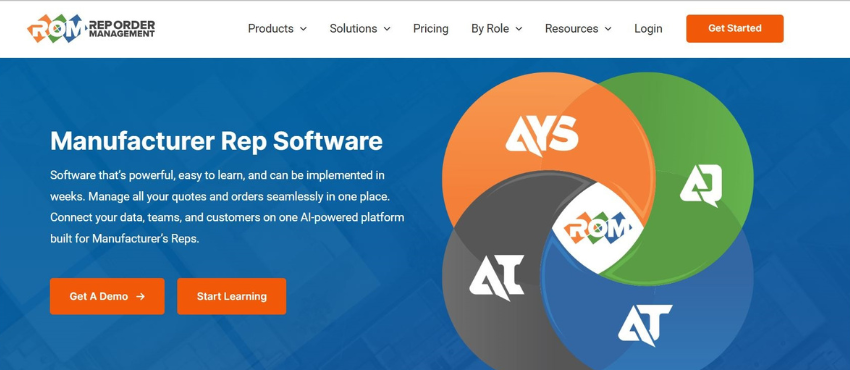
The Rep-Specific Platform Category
A software category exists specifically for manufacturer representative firms. These platforms aren’t customized CRMs. They’re purpose-built systems designed around how reps quote, track orders, manage jobs, calculate commissions, and report to manufacturers. Instead of forcing rep workflows into a generic sales structure, these platforms start with the workflow and build the system around it.
How These Systems Connect the Full Rep Process
Rep-specific platforms handle continuity that spreadsheets and CRMs can’t:
- Quotes connect to specific manufacturers, territories, and products without custom fields or workarounds.
- Orders track from submission through delivery, maintaining visibility across the entire fulfillment cycle.
- Jobs link to the right reps, manufacturers, and commission structures automatically.
- Commissions are calculated based on actual payments and manufacturer-specific rates, not generic close dates.
- Manufacturer reporting generates accurate, formatted reports without manual data compilation.
The system understands that a rep firm operates across multiple manufacturers, manages complex territories, and needs operational clarity from quote to payment. Some manufacturer rep firms use purpose-built platforms like Rep Order Management to manage quoting, orders, projects, and reporting in one system, without forcing a generic CRM to fit.

Final Verdict: CRM vs Spreadsheets for Manufacturer Reps
Spreadsheets work early. They’re simple, flexible, and cost nothing. But they fragment data, create version-control chaos, and stop scaling beyond five to ten reps. Leadership loses visibility. Reps lose confidence in the numbers. Reporting becomes a project instead of a process. CRMs solve centralization and visibility. They provide structure, pipeline management, automated workflows, and real-time data. But generic CRMs were built for direct sales teams.
They don’t handle multi-manufacturer workflows, territory-based responsibility, or quote-to-commission continuity without heavy customization. Firms end up maintaining the CRM instead of using it. Scaling manufacturer rep firms need systems designed for how reps actually operate. Not spreadsheets that break under load. Not generic CRMs that require constant workarounds.
The firms that grow without operational chaos use platforms built around rep workflows, systems that connect quoting, order tracking, job management, commissions, and manufacturer reporting in one place.
What Scaling Rep Firms Choose Next
Growth requires operational clarity. Leadership needs to see pipeline, performance, and commission data without chasing spreadsheets or fighting a CRM that wasn’t built for reps.
Rep firms that outgrow spreadsheets and generic CRMs move to platforms designed for their specific workflows. They stop customizing tools that don’t fit and start using systems that understand multi-line representation, territory complexity, and the full quote-to-commission cycle. Platforms like Rep Order Management exist because manufacturer rep firms don’t sell like traditional sales teams, and their systems shouldn’t force them to.
If your firm is evaluating what comes after spreadsheets or CRM customization, this is the category worth understanding. If you have more questions about CRMs, we can help. Schedule a time to speak with a ROM specialist.